Blog de Artesanato em Metal
A challenge coin looks simple on a desk: a metal disc with a design on it. Behind that disc sits a chain of decisions about tooling, alloy, enamel, plating, edge, packaging and freight, and every one of them can be handled well or badly by the factory you pick. For a procurement manager, a distributor or an event organizer, the real question is not “who can make a coin” but “who can make the same coin correctly, repeatedly, and deliver it to my door without surprises.”
This guide walks through how coins are actually made, what the main specification choices mean, where orders usually go wrong, and what to put in a request for quote so that suppliers can answer precisely. It is written from the manufacturing side, for buyers who place coin orders for military units, clubs and associations, corporate recognition programs, and resale channels.
Why the choice of manufacturer matters more than the choice of design
Two factories given the same artwork can return coins that look very different. Line widths, enamel fill level, plating consistency and edge quality all depend on workshop discipline rather than on the drawing. A good design on a weak production line produces a mediocre coin; a reasonable design on a disciplined line produces a coin people keep.
When you evaluate suppliers, look at the way they ask questions. A manufacturer who requests your artwork, size, quantity, finish and destination before quoting is preparing to build the right coin. One who returns a number from a one-line inquiry is guessing, and the guess usually gets corrected later through a revised quote.
How a die-struck challenge coin is made
Understanding the process lets you read a quote and a proof critically. Most premium coins follow the same sequence.
1. Artwork review and vectorization
The factory’s designers convert your artwork into clean vector lines, separating what will be raised metal, what will be recessed and what will be filled with color. Fine details are checked against what the tooling can actually reproduce. Hairline strokes, tiny text and gradients are the usual problems; a good supplier will tell you which elements need to be thickened or simplified rather than silently accepting them.
2. Die making
The approved design is engraved into a hardened steel die. Traditionally this meant hand engraving or an engraved master; today, CNC and EDM equipment cut most dies, and skilled finishing still determines how crisp the edges and recesses are. Each side of the coin needs its own die. The die is where relief height, text sharpness and surface texture are decided, which is why tooling quality is the first thing worth asking about.
3. Striking the blanks
Metal blanks are stamped under high pressure, and the metal flows into the die cavities. Thicker or deeper relief designs often require more than one strike to capture full detail. Brass is a common base for die-struck coins because it strikes cleanly and takes plating well; other metals are available for specific looks and budgets. The strike determines the “feel” of the coin, so uneven pressure or worn dies show up as soft detail.
4. Trimming and edge work
After striking, excess metal is trimmed to the final outline. Round coins are the default, but custom shapes follow the same logic with a trimming die cut to the outline. The edge can then be left plain, cut with a pattern, or treated for a particular finish. Burrs and uneven edges at this stage will carry through to the finished coin, so inspection here matters.
5. Plating and coloring
Coins are plated in the chosen metal finish, then polished or antiqued as specified. Plating thickness, bath condition and cleaning before plating all affect how the coin ages in a pocket or drawer.
6. Enamel filling and curing
If the coin has color, enamel is applied into the recessed areas by hand or with controlled dispensing, then cured by baking. Some designs are polished flat after curing; others are left with the enamel slightly below the metal lines. This is the stage where most visible quality differences appear.
7. Final finishing and inspection
Excess enamel is cleaned, metal lines are polished, and each coin is examined before packing. A good workshop treats this as a sorting stage, not a formality.
Enamel choices and what they mean for your coin
The enamel type is the choice that most affects both look and price. The same families used on pins apply to coins; our article on the five main types of enamel pins explains each in more detail.
| Option | How it looks | Best suited to | Points to check |
|---|---|---|---|
| Esmalte macio | Color sits below the raised metal lines, giving a textured, tactile surface | Detailed artwork, designs where relief is part of the appeal | Surface can collect dirt unless an epoxy dome is added |
| Hard (imitation hard) enamel | Color polished flush with the metal lines, smooth surface | Corporate and formal programs, designs that need a refined finish | Needs adequate line width to hold the color cleanly |
| No enamel (metal only) | Relief carried entirely by polish and texture contrast | Minimal designs, antique-style coins | Artwork must rely on texture, not color |
| Epoxy dome over color | Clear protective layer over the enamel | Coins handled often, where color protection matters | Dome should be even and bubble-free |
| Glitter, translucent or glow effects | Special enamel formulations | Event coins and promotional runs | Confirm color matching with the factory first |
If you are unsure, ask for a recommendation based on your artwork. Dense fine-line artwork usually works better with soft enamel; clean, bold designs suit hard enamel. The decision should come from the design, not from a habit.
Plating and edge finishes
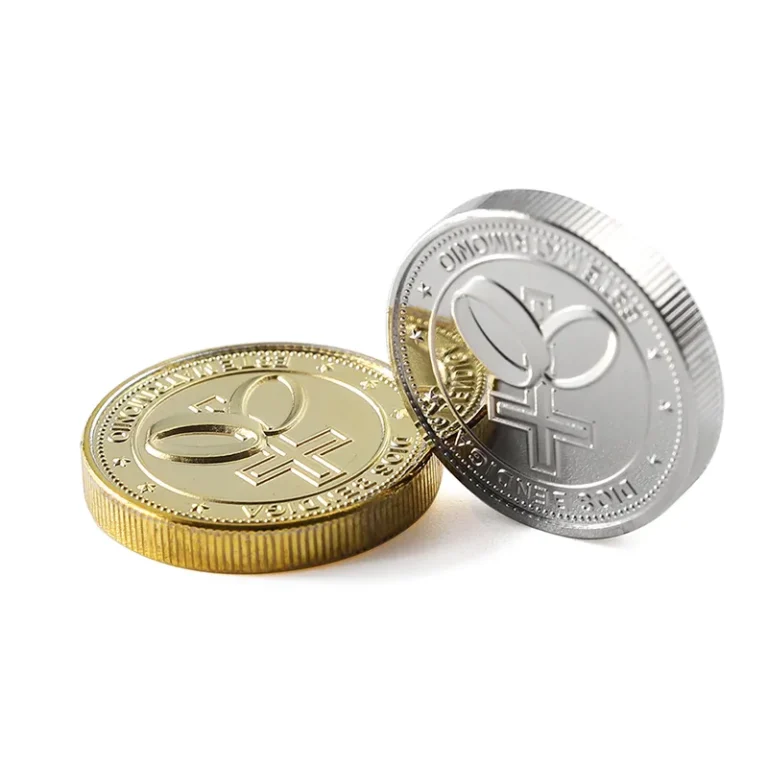
Finish determines the character of a coin more than most buyers expect. The common choices include gold, silver, nickel, copper, antique variants of each, black nickel and dual-tone combinations. Antique finishes darken the recesses and leave high points bright, which emphasizes relief; polished finishes look striking but show handling marks. If coins in one order must match, specify the finish by sample or standard reference, not by name alone.
Edges are a separate decision. A smooth edge is the default. Cut or patterned edges add a distinctive feel and are a common upgrade for presentation coins. Rope, reeded and similar patterns each require die work, so confirm availability and any tooling implications at the quoting stage.
2D versus 3D designs
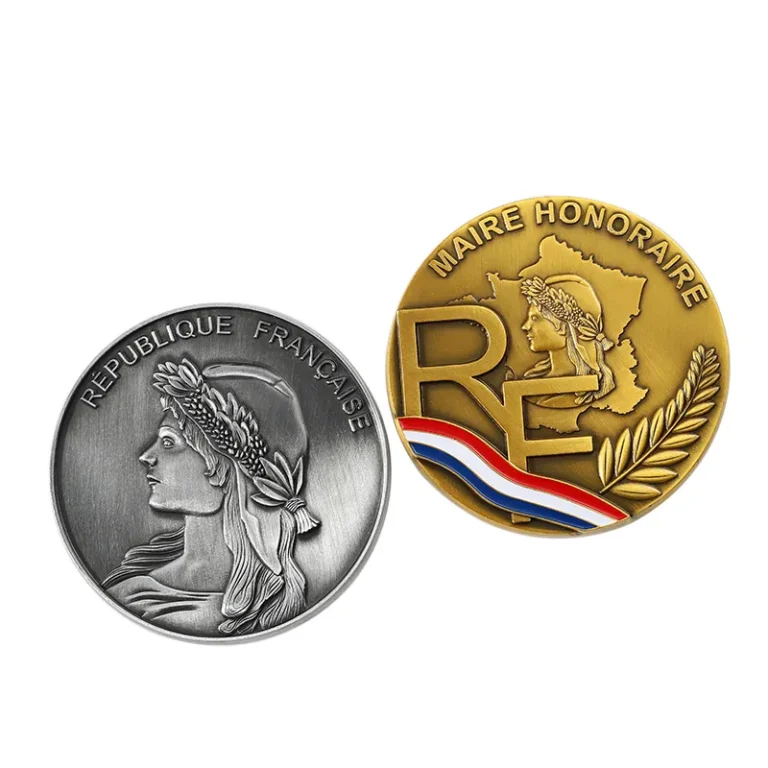
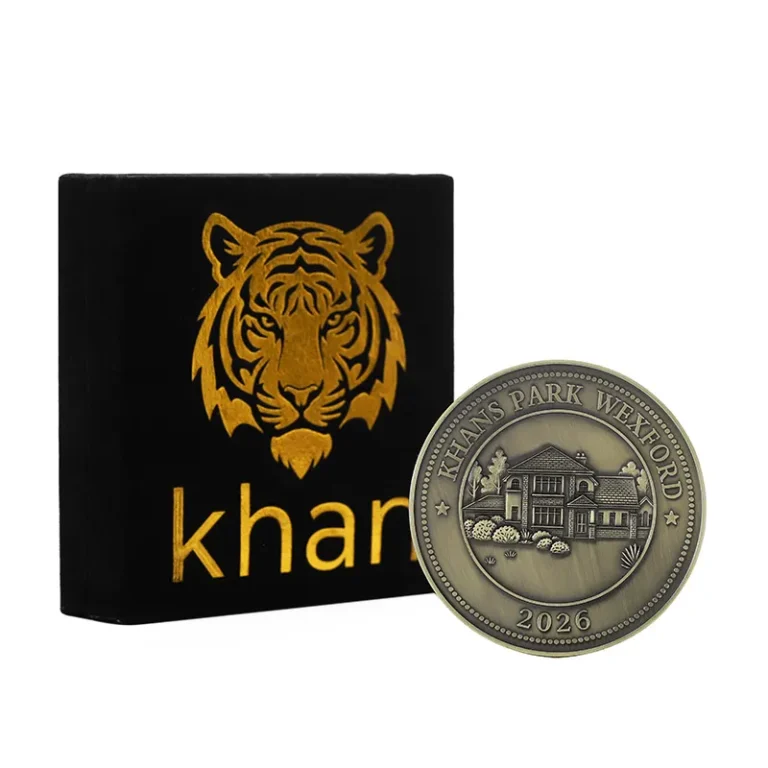
A 2D coin has a mostly flat relief with defined metal lines separating colors. A 3D coin has sculpted, multi-level relief with curves and layered surfaces. Neither is “better”; they serve different artwork.
Choose 2D when the design is logo-driven, text-heavy or needs fast, clean readability. Choose 3D when the subject is a figure, building, emblem with dimension, or an object whose shape defines the idea. Fully 3D designs need more tooling skill and typically more careful proofing, because the sculpted shapes cannot be judged from a flat drawing alone.
Artwork proofs, mold approval and sampling
This is the stage where most disputes are prevented.
Digital proof. Before any die is cut, you should receive a mock-up showing the shape, size, colors, plating and any special features. Check spelling, dates, unit names and numbers character by character. Typos found after striking are expensive.
Physical sample. For a large order or a program with strict standards, a sample coin made on the production tooling lets you judge weight, relief, enamel fill, edge and plating before committing. Samples are a paid step because they require real tooling and labor; the cost is usually small compared with the risk of approving a full run from a screen image alone.
Written approval. Whatever you approve, record what was approved: proof version, colors, plating, edge, and any changes requested. When a dispute arises later, this record is what both sides rely on.
Quality control: what to ask and what to look for
Ask a prospective manufacturer how inspection is organized instead of whether they “have QC.” Useful questions include whether inspection happens at several stages, who has authority to reject a batch, and how defective pieces are separated.
At delivery, buyers can check coins against a short list:
- Enamel fill is level and consistent, with no pinholes, bubbles or color crossing a metal line.
- Metal lines are crisp, and text is legible at its intended size.
- Plating is uniform, without patches, scratches or bare spots.
- Edges are clean, with no burrs.
- Size, thickness and weight are consistent within a reasonable tolerance across the batch.
- Coins match the approved proof and sample in color, finish and detail.
FOR UNITS, AGENCIES & COMPANIES
Choosing a challenge coin manufacturer?
Hesank strikes custom challenge coins in our own factory. Send a logo or sketch and get a free design proof and a quote. MOQ 50 pcs, free design proof, 12–15 days production.
Veja as moedas personalizadas para desafiosPeça um orçamento gratuito →
Packaging and presentation
Packaging is part of the product for coins that are awarded, gifted or resold. Options range from individual poly bags to cases, boxes, display stands and pouches, and the right choice depends on how the coin will be used.
For resellers and distributors, individual protective packaging reduces scratches during transit and storage, and makes units ready for shelf or online fulfillment. For ceremonial and corporate use, a presentation box or case adds perceived value at the moment of award. If you need custom printed packaging or inserts, raise it at the quote stage because it affects planning and shipping volume.
Shipping, duties and delivery terms
Many problems for importers come from unclear responsibility for freight and duties. DDP (Delivered Duty Paid) terms mean the supplier arranges delivery to your destination and handles import duties and taxes, so you receive a single, clear landed cost. Hesank delivers on this basis to more than 30 countries. Whatever the terms, confirm in writing who is responsible for freight, customs clearance, duties and last-mile delivery. Provide a full address and contact, and mention compliance or documentation needs early.

Common mistakes buyers make
- Comparing quotes that are not like for like. One supplier quotes basic soft enamel with no packaging, another quotes hard enamel with individual bags. Align specifications before comparing totals.
- Approving artwork without checking the text. Names, ranks, dates and numbers are the most common errors.
- Choosing a finish by name only. Request a reference sample or standard.
- Skipping a sample on a large or repeating program. A paid sample is inexpensive insurance.
- Forgetting reorders. If you plan to order again, ask how the factory stores and reuses tooling so later batches match earlier ones.
RFQ checklist for different buyer types
A complete request lets a manufacturer answer once, accurately. Include the following for any coin project:
- Artwork file (vector preferred) or a clear description and references
- Size, thickness and shape, with 2D or 3D preference
- Quantity, and whether you expect repeat orders
- Enamel type, color references and plating finish
- Edge style and any special features
- Packaging requirements
- Delivery country and address, and required trade terms
- Target delivery date and any fixed event deadline
Then add the points specific to your type of program.
Military units and government programs. State any required emblems, mottos or numbering conventions, and any documentation or labeling required for delivery. Mention individual numbering or serial requirements early, as they influence production planning. Confirm the supplier is comfortable with confidential or restricted artwork.
Clubs, associations and event organizers. Fix the event date first and work backward. State whether coins will be handed out or sold, as this affects packaging. If members will receive them one by one, ask about individual bags or cards.
Corporate recognition and branding programs. Provide brand color references and logo usage rules. Ask how consistency is handled across multiple runs and locations, and whether tooling is retained for future orders.
Resellers and distributors. Ask about packaging ready for retail or online fulfillment, labeling, and how assorted designs can be packed and shipped. Check whether the supplier can support repeat designs and series with matching quality over time.
You can start a structured inquiry through our challenge coin quote form, or review current challenge coin options before you brief us.
Related products for the same program
Many buyers who order coins also need related items that share the same artwork: distintivos de lapela for daily wear, medalhas for ranked awards, or other custom pieces. Running these through one supplier makes colors and finishes easier to keep consistent across the program. For an overview of what is possible, see our custom manufacturing page.
Frequently asked questions
What file format should I send for a challenge coin design?
Vector files (AI, EPS, PDF or SVG) are best because lines scale cleanly and the factory can work from exact shapes. High-resolution images or even sketches can still be used; the design team can redraw them, though a redraw adds a step to proofing.
How do I choose between soft and hard enamel?
Soft enamel leaves the color recessed, so the metal lines remain tactile and the surface has depth. Hard enamel is polished flat for a smooth, refined surface. Fine detail often suits soft enamel, while bold, clean designs suit hard enamel. A manufacturer should be able to recommend one based on your artwork.
Are samples free?
No. Physical samples require real tooling and labor, so they are charged. For larger or repeating programs the sample cost is generally small relative to the order, and it lets you confirm color, relief and finish before full production.
Can the same coin be reordered later with identical results?
Generally yes, provided the tooling and approved specifications are retained. Ask the manufacturer how tooling is stored, and keep your approved proof and color references on file so any future batch can be matched against them.
Leitura relacionada: preços das moedas comemorativas, choosing a challenge coin maker e como são fabricados os moldes para moedas. Navegar moedas militares.
Request a quote for your coin project
If you are comparing manufacturers, send us your artwork, size, quantity, finishes and destination, and we will respond with a specification you can check line by line. Start with the challenge coin quote form ou contact our team with any questions about materials, finishes or delivery. Wenzhou Hesanqian Crafts Co., Ltd. has been manufacturing metal crafts since 1996 and delivers DDP to more than 30 countries.