Blog sur l'artisanat du métal
Security officers stand at the front door of offices, hospitals, campuses, warehouses and events, and the badge on their uniform is often the first thing a visitor looks at. A well-designed security badge tells people at a glance who the officer works for, what role they hold and how to identify them later, and it does all of this without ever being mistaken for a police badge.
This guide is written for security company owners, operations managers and procurement teams. It covers the main types of security guard badges, the rules you should check before you approve a design, the materials and finishes that last on a uniform worn every day, and a practical checklist for ordering custom badges for a team of any size.
Why Security Badges Are Different From Police Badges
Police badges identify sworn officers who hold legal powers such as arrest. Security badges identify employees or contractors of a private company. That difference matters to the public, and it is why many states, provinces and licensing agencies regulate how private security badges may look.
Although the details vary, the most common requirements and restrictions include:
- The word “Security”, “Security Officer” or “Private Security” must appear clearly on the badge.
- Words such as “Police”, “Law Enforcement”, “Detective”, “Sheriff” or “Officer of the Law” are not allowed on their own.
- Official state, county or city seals cannot be used without permission from the government body that owns them.
- Some jurisdictions restrict shapes, colors or layouts that closely copy the badges of local police departments.
- Some states require the company name or license number to be visible on the badge or on a separate ID card worn with it.
Because these rules differ from state to state and are updated from time to time, the safest approach is to confirm the current requirements with your state’s private security licensing board, or the equivalent agency in your country, before you sign off on artwork. Keep a copy of any written approval with your order records. A reputable badge manufacturer will build the design around those rules from the start, rather than asking you to change a finished mold later.
If you are curious how police departments structure their own badge numbers, our guide on how many numbers are found on a police badge explains the common formats.
The Main Types of Security Guard Badges
Most security teams use a combination of two or three badge types. Choosing the right mix depends on the uniform, the site and how often officers need to show identification.
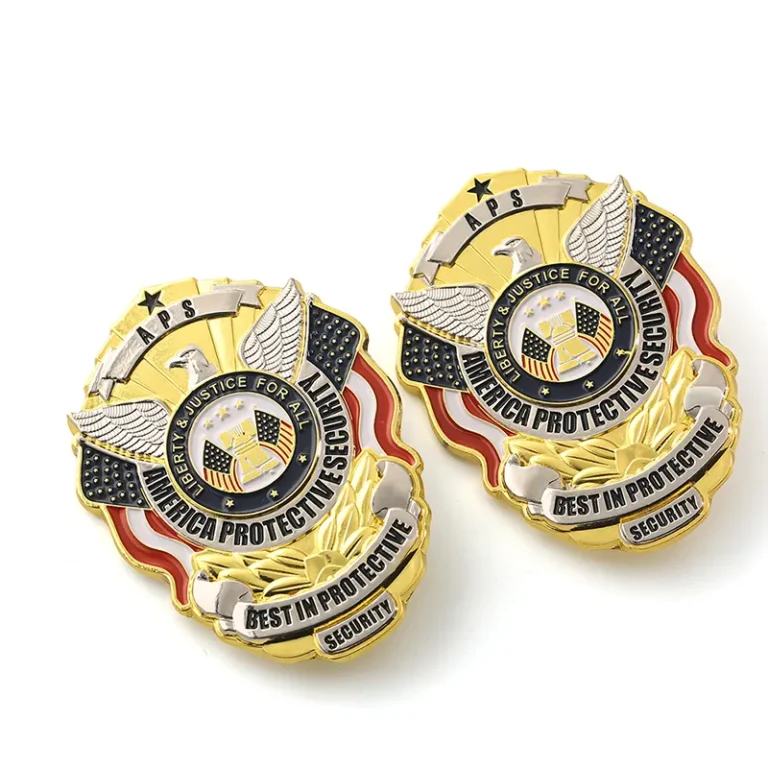
Breast badges
The classic metal badge worn on the left chest of the uniform shirt or jacket. Breast badges carry the most information: company name, the word “Security”, the officer’s title and a unique badge number. Shields, stars, ovals and eagle-topped designs are the most common outlines, although many companies now prefer simpler shapes that look modern and clearly non-police.
Typical sizes range from about 2.5 to 3.5 inches (64–89 mm) tall. Larger badges are easier to read from a distance but add weight, so they are usually paired with a strong clutch or a pin with a safety catch.
Hat badges
A smaller version of the breast badge, usually 1.75 to 2.5 inches tall, designed to fit the front of a peaked cap or patrol hat. Many companies order breast and hat badges as a matching pair from the same artwork, which keeps the look consistent and saves design time.
Wallet badges
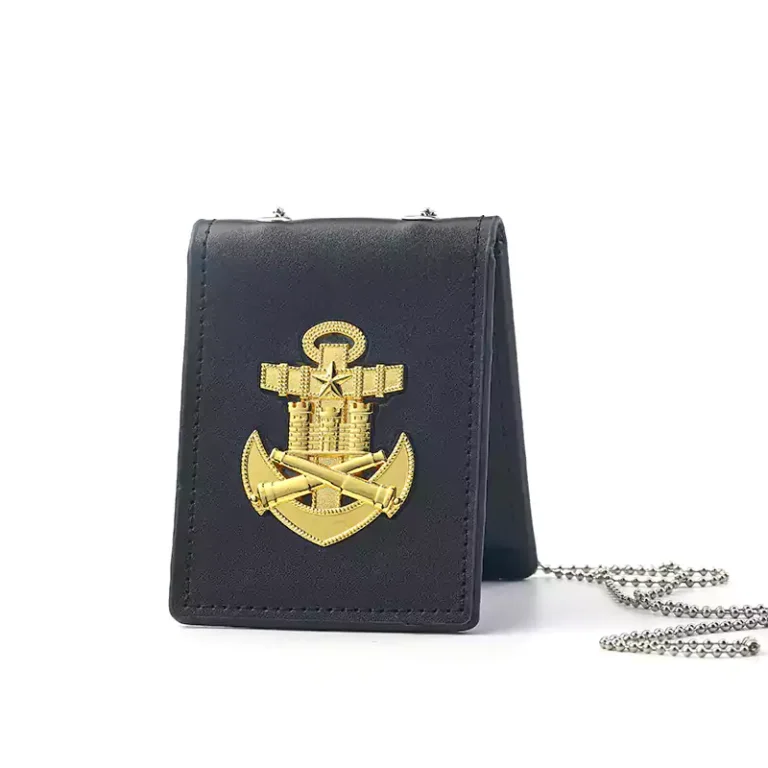
Supervisors, mobile patrol staff and plain-clothes officers often carry a badge in a leather wallet together with their license card. The badge sits in a cut-out window so it can be shown quickly when entering a site or speaking with police and emergency services. Wallets can be embossed with the company name for a more professional finish.

Shoulder and sleeve insignia
Some security uniforms use metal shoulder badges or epaulette insignia to show rank, especially for supervisors and site managers. Metal insignia last longer than fabric patches and look sharper on dress uniforms used at corporate sites and events.
Lapel pins, name plates and ID badges
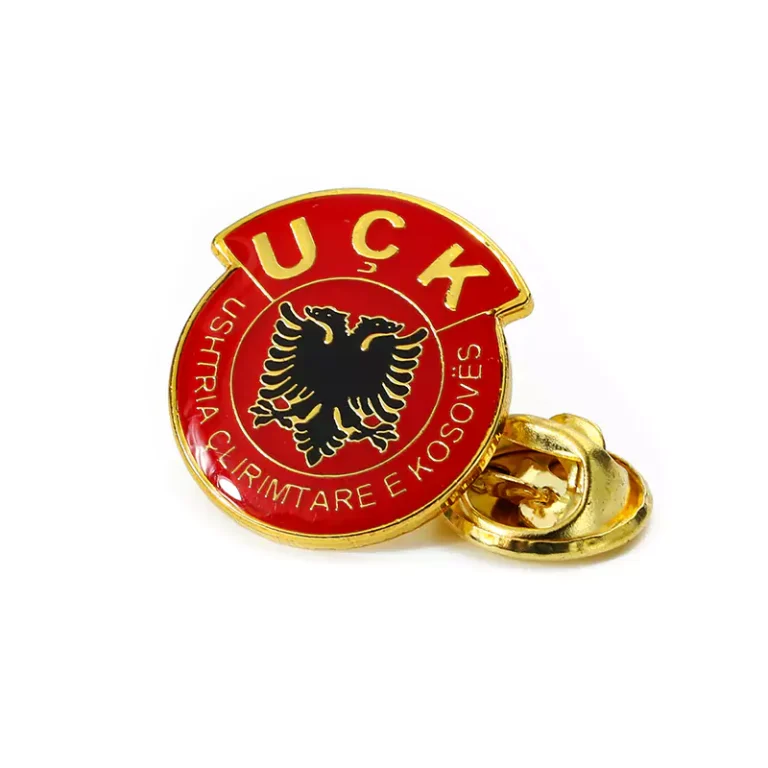
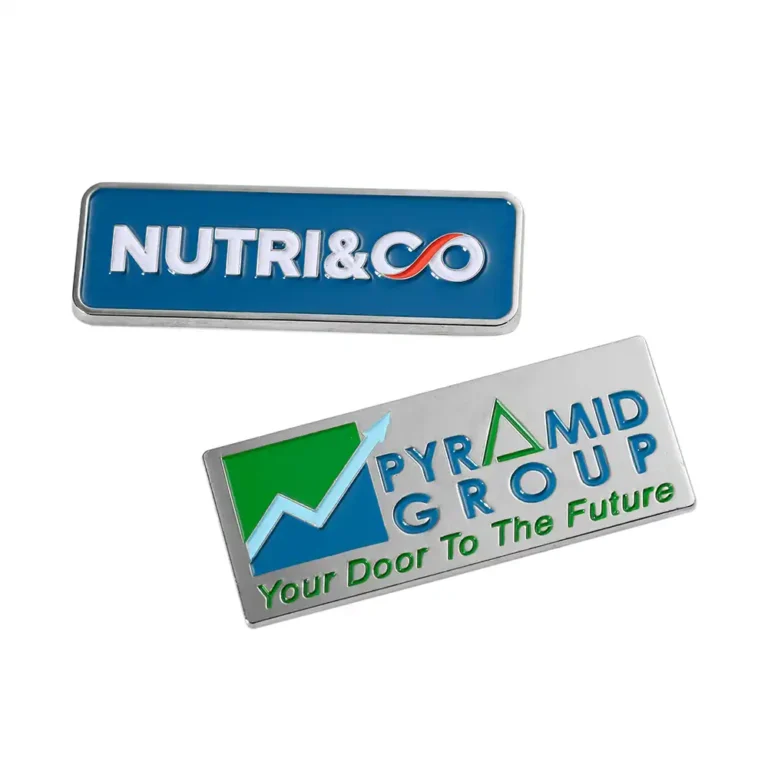
For front-desk, reception and corporate security roles, a large shield can feel intimidating. A small logo pin, a metal name plate or a magnetic name badge looks more approachable while still identifying staff clearly. Name plates are also easy to update when staff change, and magnetic backs avoid damaging suits and blazers. You can see examples among our badges nominatifs personnalisés.
Choix des matériaux et des finitions
A security badge is worn every day, through rain, sun, car doors and seat belts. The right materials and finishes make the difference between a badge that still looks sharp after three years and one that fades, chips or bends within months.
Base metal
- Zinc alloy (die-cast): molten metal is cast into a mold, which allows detailed 3D shapes, cut-outs and raised lettering at a lower cost. It is the most common choice for badges with complex outlines.
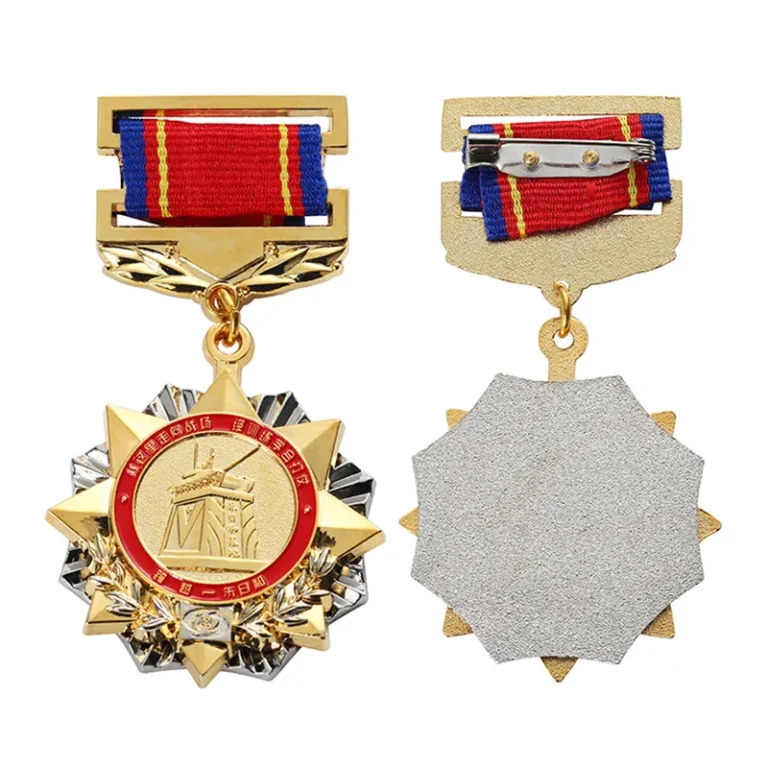
- Brass or copper (die-struck): the design is stamped into a solid metal blank under high pressure. The result is heavier, with very crisp lines and edges. Brass is a good choice when you want a premium, traditional feel.
- Iron (die-struck): a cost-effective option for simpler, flatter designs and large quantities.
Placage
- L'or plating is often used for supervisors and managers.
- Silver (nickel) plating is common for officers.
- Two-tone plating (gold and silver on the same badge) adds contrast to the center emblem or banner.
- Antique finishes (antique gold, silver or bronze) hide small scratches well on badges that see heavy use.
Using plating color to show rank is one of the simplest ways to make supervisors easy to spot without changing the design.
Émail
- Émail doux fills the recessed areas but sits slightly below the raised metal, so the surface has a textured feel. It is economical and shows color well.
- Émail dur is filled level with the metal and polished smooth. It resists scratches and fading better and gives a jewelry-like finish, which suits badges worn every day.
- Epoxy coating can be added over soft enamel for extra protection and a glossy look.
Backs and attachments
- Pin with safety catch: the traditional uniform badge back, holds securely through fabric.
- Butterfly or rubber clutch: easy to attach and remove, suitable for lighter badges and pins.
- Clip-on or belt clip: lets officers wear the badge on a belt or pocket.
- Wallet clip: fixes the badge into a leather holder.
- Magnet: ideal for name plates on suits and blazers.
For tips on keeping badges and holders in good condition, our article on caring for a badge and holder applies equally to security badges.
What to Put on a Security Badge
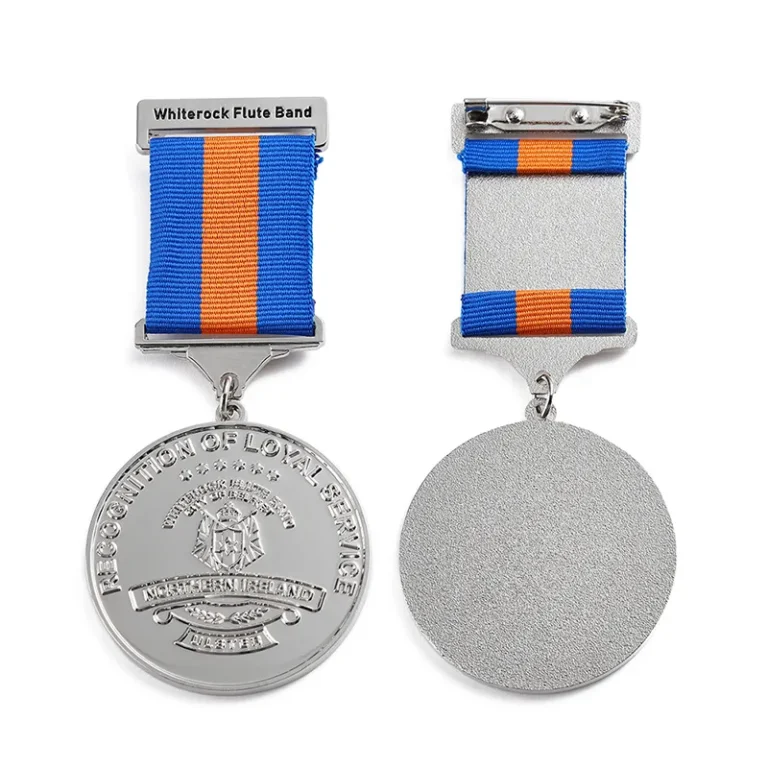
Every element on a badge should help the public identify the officer quickly. A cluttered badge is harder to read and harder to produce. Most effective security badges include:
- Company name: the main line of text, usually on a curved banner at the top.
- The word “Security”: clear and readable, as most regulations require.
- Role or title: “Security Officer”, “Supervisor”, “Site Manager” or “Patrol”.
- Badge number: stamped, engraved or enamel-filled, unique to each officer.
- Center emblem: your company logo or a neutral symbol, never a government seal you do not have permission to use.
- Optional details: city or state name, the year the company was founded, or a short motto.
Keep text short and at least 1 mm tall in the final metal so it stays readable after plating and enamel filling. Your manufacturer should send a digital proof at real size so you can check legibility before production.
Badge Numbers: How to Plan Them
Numbered badges make it easy to link an officer to an incident report, a shift log or a visitor complaint. They also discourage misuse, because every badge can be traced to one person. A few practical tips:
- Use a consistent format, for example a site or region prefix plus a sequence number (such as 12-045).
- Prepare a numbering list in a spreadsheet before you order, so the factory can stamp or fill each number correctly.
- Order spare numbers for new hires, or a set of badges with blank number panels that can be engraved later.
- Record which number belongs to which officer and collect badges when staff leave.
Numbers can be added by stamping into the metal, laser engraving or applying enamel-filled digits. Stamping and enamel give the most durable result for badges worn every day.
FOR SECURITY COMPANIES
Ordering badges for your security team?
Hesank is a badge factory, not a reseller. Since 1996 we have made die-struck security badges with your company name, officer titles and individual numbers, in hard or soft enamel with gold, silver or two-tone plating, plus matching hat badges and leather wallets. MOQ 50 pcs, free design proof, 12–15 days production.
Browse Custom Police & Security BadgesObtenez un devis gratuit →
Designing for Different Ranks and Sites
Larger security companies often need several variations of the same badge: officers and supervisors, different contract sites, or special teams such as event security and mobile patrol. Rather than creating a new design for each, most companies use one master design with small changes:
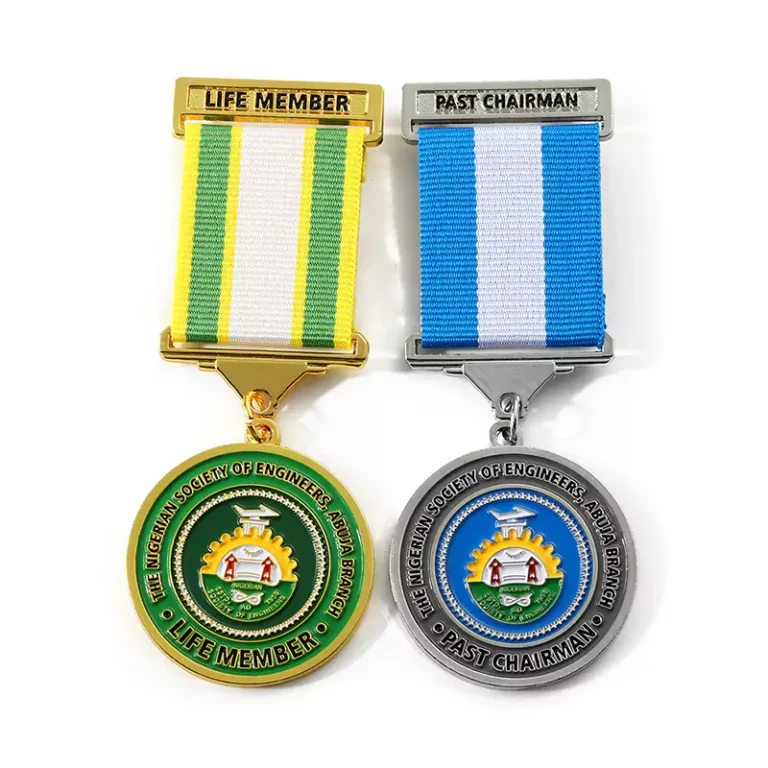
- Different plating (silver for officers, gold for supervisors).
- Different rank panels on the lower banner.
- Different enamel colors for special teams.
- Different site names on interchangeable panels.
Because one mold can be produced in several platings and enamel colors, this approach keeps costs low and the whole team looking consistent. Browse our wider custom metal badge collection for shapes and finishes you can adapt.
Checklist Before You Order
- Confirm your state’s badge rules and keep any written approval with your records.
- Decide which badge types you need (breast, hat, wallet, name plate) and how many of each.
- Choose plating and enamel colors for each rank.
- Prepare a numbering list if each badge needs a unique number.
- Send your logo in vector format (AI, EPS, PDF or SVG) if you have it.
- Plan for growth: order extra badges or blank-number badges for new hires.
- Agree on delivery dates, especially if the badges are needed for a new contract start.
How the Ordering Process Works
- Send your idea: a logo, a sketch, or a photo of a badge you like as a reference for shape and layout.
- Receive a design proof: our designers prepare a real-size digital proof with colors, plating and numbering marked.
- Approve and confirm details: quantities, numbering list, backs and packaging.
- Mold and production: the mold is made and badges are produced, plated, enamel-filled and inspected. Production usually takes 12–15 days after approval.
- Shipping: express delivery typically takes 3–6 days, with DDP options so duties and taxes are handled in advance.
Most of our security clients start with 50–200 badges and reorder as their teams grow. Because the mold is kept on file, reorders are faster and cheaper than the first order, and new numbers can be added at any time.
Les erreurs courantes à éviter
- Copying a local police badge: even with “Security” added, a near-copy can breach regulations and confuse the public.
- Too much text: small lettering becomes unreadable after plating.
- Using a government seal: only use official seals with written permission.
- Ordering exactly the current headcount: new hires then wait weeks for a reorder.
- Choosing the cheapest back: a badge that falls off during a shift is a security problem in itself.
FAQ
Can security guards wear badges that look like police badges?
Generally no. Most jurisdictions require security badges to be clearly different, including the word “Security” and excluding police terms and official seals. Check your state’s rules before production.
Do security badges need numbers?
Not always, but numbered badges make it easier to identify officers in reports and complaints, and many clients and contracts prefer them.
What is the minimum order for custom security badges?
At Hesank the minimum is 50 pieces per design. Numbering, plating and rank panels can vary within the same order.
Combien de temps dure la production ?
Usually 12–15 days after you approve the design proof, plus around 3–6 days for express shipping.
Can you match our existing badge design?
Yes. Send photos of your current badge from the front and back, with its size, and we will recreate it or improve the details.
Do you supply badge wallets and holders?
Yes. We make leather wallets and holders cut to fit your badge, and they can be embossed with your company name.