Blog sur l'artisanat du métal
Pick up a challenge coin and the first thing you notice is not the design. It is the weight, the edge and the way the metal rings when it hits a table. Those qualities come from the process that made the coin, and for custom orders the choice usually comes down to two methods: die striking (stamping) and die casting. Both produce excellent coins. They are good at different things, and choosing the wrong one for your artwork is one of the most common reasons a finished coin looks different from the proof you imagined.
Hesank has been making custom metal crafts in Wenzhou, China since 1996, and our workshop produces coins by both methods. This guide explains how each process works, what each does well, where each struggles, and how to decide between them before you request a quote. If you only want the short version: choose die struck for flat, crisp, text-heavy designs, and choose die cast for deep 3D relief, cut-out shapes and unusual outlines.
The Short Answer: Die Struck vs Die Cast at a Glance
| Die struck (stamped) | Die cast (zinc alloy) | |
|---|---|---|
| How the shape is made | A metal blank is pressed between steel dies under heavy pressure | Molten metal is injected into a mold and cools into shape |
| Typical metals | Brass, copper, iron | Alliage de zinc |
| Best at | Flat designs, sharp lettering, fine lines, dense solid feel | Deep 3D relief, cut-outs, irregular shapes, thick or oversized coins |
| Profondeur du relief | Moderate | Deep and sculpted |
| Shape freedom | Round and simple outlines work best | Almost any outline, holes and separate cut-out areas |
| Sampling time (Hesank) | 5-7 jours | 3D casting usually adds 2–4 days to the 5–7 day sample |
| Standard production time | 12–15 days after sample approval | 12–15 days; complex 3D, double plating or multi-color work runs 20–25 days |
The rest of this article explains the reasons behind each row, so you can judge your own design rather than rely on a rule of thumb.
How Die Striking Works
Die striking is the oldest way of making a coin, and the principle has not changed in centuries. A hardened steel die is engraved with your artwork in reverse. A flat metal blank, usually brass, copper or iron, is placed between the two dies and struck in a press. The pressure is enormous, and the metal is forced into every recess of the die. Nothing is melted. The blank is cold-formed, which is why a struck coin feels dense and solid.
For a typical enamel coin, the struck metal forms raised walls (the metal lines of the design) with recessed areas between them. Those recesses are then filled with colored enamel, baked, and plated. Because the metal is displaced rather than poured, struck coins hold very sharp lettering and thin lines. If your design is a crest with a ring of small text, a motto in a banner and fine linework, striking is usually the process that renders it most crisply.
The trade-off is relief depth. A press can only push metal so far in one strike, so die struck coins are best described as flat or low relief. You can have texture, stepped levels and polished-versus-sandblasted contrast, which together give a lot of visual interest, but you will not get a sculpted face with an undercut nose or a coin whose edge is cut into the shape of an animal.
How Die Casting Works
Die casting works the opposite way. Instead of pressing a solid blank, the factory machines a steel mold in the shape of your coin and injects molten zinc alloy into it under pressure. The metal fills the mold, cools, and is released as a finished blank with the design already formed. Because the metal flows as a liquid, it reaches places a press cannot: deep relief, curved surfaces, separate raised elements, and shapes with holes or cut-outs.
This is the process behind 3D challenge coins such as sculpted portraits, vehicles, animals, building facades and mascots. It is also the process of choice when the outline of the coin is not a circle at all: a shield, a map of a state, an aircraft silhouette, a bottle-opener shape or a coin with an open center. If you can describe your coin as a small sculpture rather than a flat picture, it is almost certainly a casting job.
The finishing steps are the same as for struck coins: polishing, plating, enamel fill where required, and final inspection. The difference is in the starting blank. Zinc alloy is lighter than brass, so a cast coin of the same diameter and thickness will weigh less in the hand. Many buyers never notice, but if weight is part of the impression you want to make, say so in your inquiry and we will discuss thickness and metal.
Where Each Process Is Strongest
Choose die struck when…
- Your artwork is mostly flat with small text, thin lines or detailed crests.
- You want the dense, heavy feel that comes with brass or copper.
- The coin will be carried or handled often, such as a unit coin, club coin or executive recognition coin.
- The outline is round, or a simple shape such as an oval or hexagon.
- You want a classic, traditional look with polished metal and crisp edges.
Choose die cast when…
- Your design is three-dimensional: sculpted figures, layered elements, or deep relief.
- The outline is irregular, or part of the coin is cut away.
- The coin is larger or thicker than the standard size.
- You want special features such as an integrated bottle-opener edge or a hollowed center.
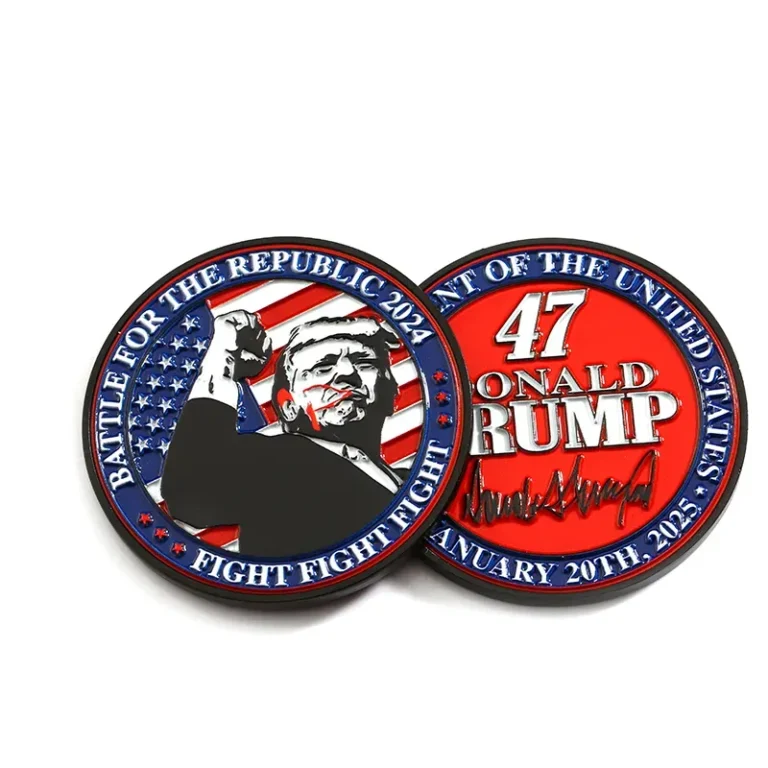
- The design combines relief with painted or enamel color across several levels.
Some designs sit on the boundary. A military unit coin might have a detailed crest on the front, which suits striking, and a sculpted emblem on the back, which suits casting. In those cases the answer is rarely “one or the other” as a matter of taste. It is a question of which side matters more and what the artwork actually contains. That is why we look at the artwork before recommending a process.
NOT SURE WHICH PROCESS FITS?
Send your artwork and we will tell you which method suits it.
Hesank makes custom challenge coins in our own factory, by die striking and by die casting. Send a logo, sketch or reference photo and we will recommend a process, size and plating. MOQ 50 pcs, free 2D design mockups with unlimited revisions, 12–15 days production after sample approval.
Detail, Texture and What You Will Actually See
Two coins can have the same diameter, the same enamel colors and the same plating and still look very different because of how the metal was formed. A few differences are worth understanding before you approve a design.
Line sharpness. Because struck metal is compressed into the die, the raised lines are tightly defined. On a cast coin, molten metal needs a little room to flow, so extremely thin lines and very small lettering can look slightly softer. For typical logos and mottos the difference is hard to see. For a seal with a ring of tiny text it can matter.
Relief and layers. Cast coins can carry several distinct levels at once, for example a raised figure standing in front of a recessed background with a third level for fine details. This layered look is what makes 3D coins stand out on a shelf. Struck coins can show levels, but with a shallower range.
Edges. Struck coins are typically finished with a round, clean edge, and decorative edges such as rope or serrated patterns are a common option. Cast coins take their edge from the mold, which is how cut-out shapes and custom outlines become possible.
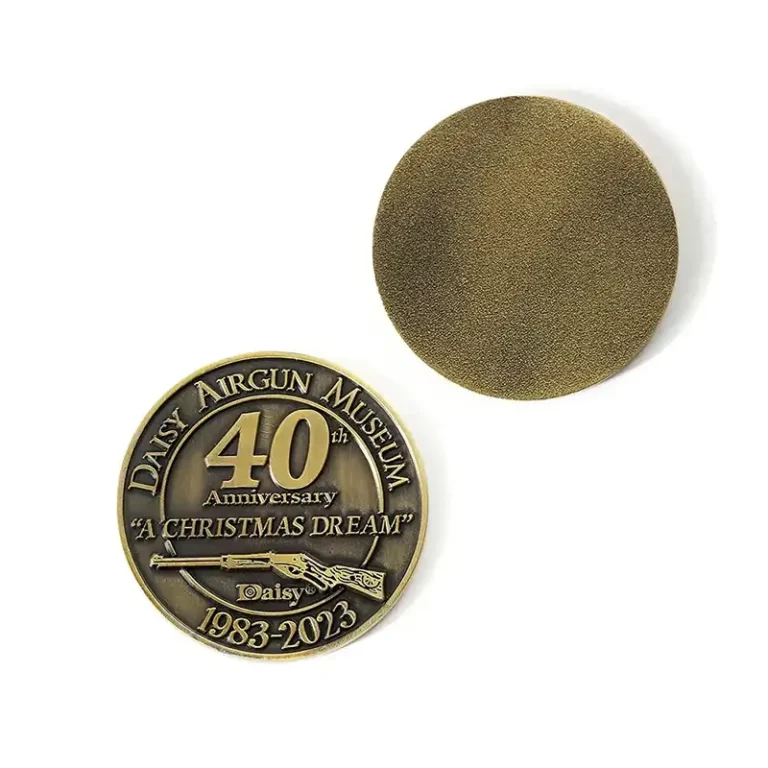
Surface and plating. Both types can be plated in gold, silver, nickel, antique bronze, black nickel and other finishes. Antique plating looks particularly good on deeper relief because the darker tone settles in the recesses and the polished high points catch the light. Dual plating, where two finishes appear on one coin, is possible on both, but it adds steps and time.
The important point is that none of these differences means one process is “better quality.” A well-made struck coin and a well-made cast coin are both high-quality products. The right question is which one is better matched to your artwork.
Examples of 3D and Painted Designs
The coins below show the kind of artwork where depth, color and finish all work together. When you request a quote, you can point to a design you like and we will explain how it was made and what would change for your own version.
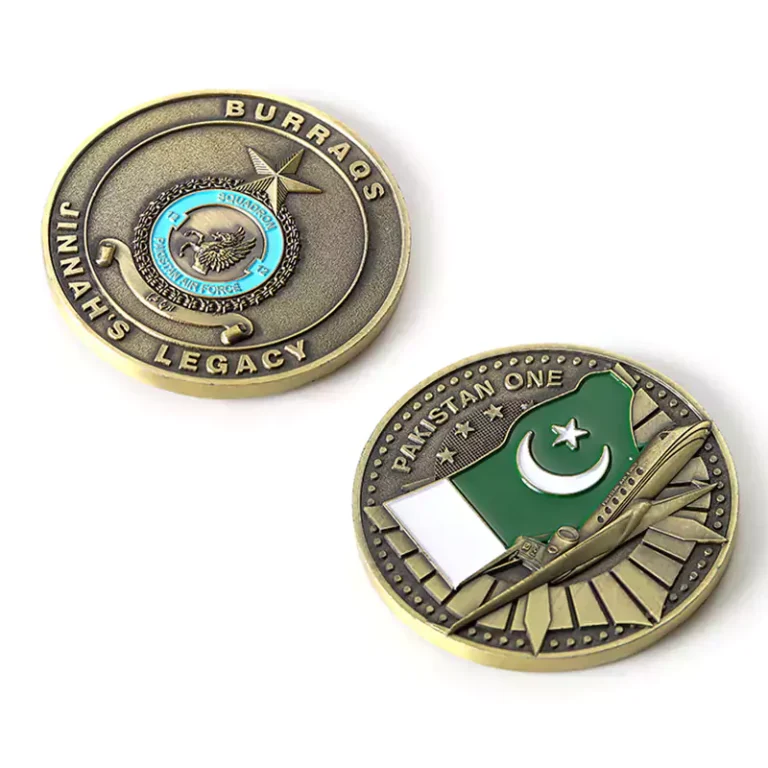
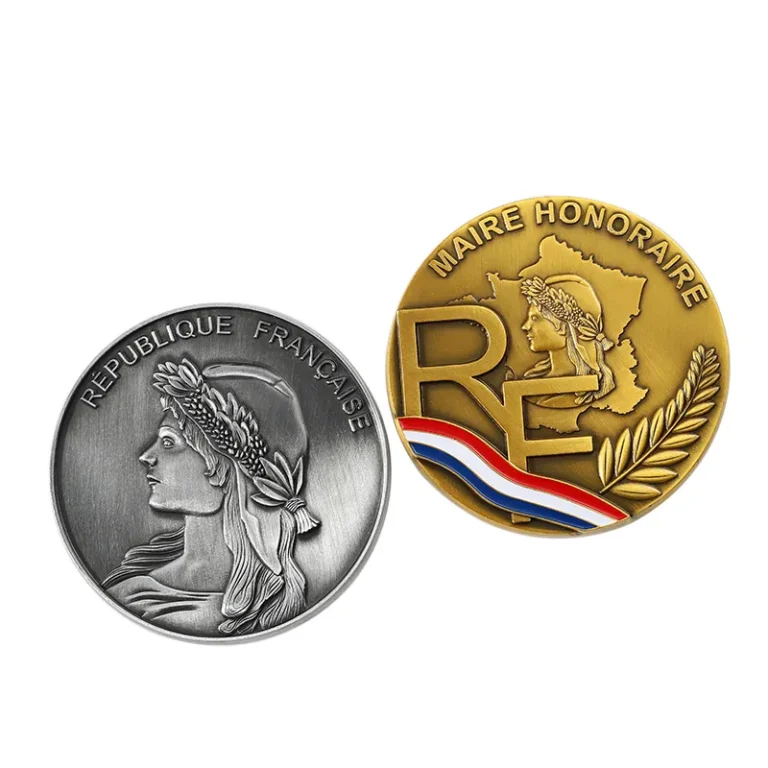
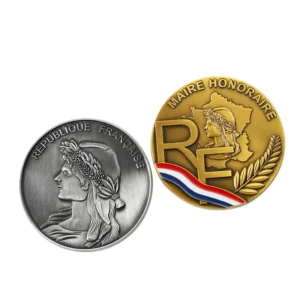
If your design is closer to a classic commemorative coin, with a clean emblem, text and a single plating finish, these are the type of pieces to browse:
How Metal Choice Fits In
The process and the metal are linked. Die struck coins are normally made from brass, copper or iron blanks, while die cast coins are made from zinc alloy. That connection explains most of the “feel” differences people describe.
- Laiton is dense and takes plating well. It is the traditional choice for coins meant to be carried and handled.
- Cuivre is softer and strikes beautifully, which makes it a common choice for antique bronze and copper finishes.
- Le fer is a lower-cost option for large-quantity promotional coins where budget leads the decision.
- Alliage de zinc flows well into detailed molds, which is why it is the standard for casting.
If you are not sure which metal suits your use, describe how the coin will be used: handed out at an event, presented in a box, carried in a pocket or displayed in a case. That tells us more than any specification sheet.
Enamel and Color on Struck and Cast Coins
Color is applied the same way on both types. The recessed areas created by the dies or the mold are filled with enamel, baked and polished or left with a textured surface depending on the style. Soft enamel leaves the metal lines slightly raised above the color. Hard enamel is filled level and polished smooth. If you are still deciding between the two, our guide on hard enamel vs soft enamel goes through the differences in detail, and the same principles apply to coins.
A few cautions are worth knowing. Very small color areas, thinner than the metal lines around them, are difficult to fill cleanly on any coin. Large areas of one color on a deeply sculpted surface can look flat, so designers often keep part of the surface as polished metal to preserve contrast. And if your design includes gradients or photographic detail, ask about printing as an alternative to enamel.
What About Cost?
Both processes need tooling. A struck coin needs engraved dies, and a cast coin needs a machined mold. At Hesank the tooling is a one-time mold fee for each new design, and it includes sampling. The molds are stored free for 5 years, so a reorder in that period does not pay the mold fee again. If a single design reaches 10,000 pieces in one order, the mold fee is waived, and if several orders of the same design reach 10,000 pieces in total, the mold fee already paid is refunded.
Beyond tooling, the per-piece price depends on size, thickness, number of colors, plating, packaging and quantity far more than on the process alone. A simple struck coin and a simple cast coin can be quite close in price, while a complex 3D casting with several colors and dual plating will cost more than either. We do not recommend choosing a process just to save money. Choose the one that renders your design properly, then adjust size, finish and quantity to meet your budget. For a deeper look at what moves the price of a coin order, read our challenge coin pricing guide.
Timeline: How Process Affects Lead Time
Lead time is another place where process matters, though less than most buyers expect. After you approve the design, the sample takes 5–7 days. Casting a 3D design usually adds 2–4 days to that stage because the mold is more involved. Once you approve the sample, standard production takes 12–15 days. Complex specifications such as 3D casting, double plating or multi-color work take 20–25 days. If you need a faster delivery, tell us your event date in the first message; rush production is possible with an additional charge.
Shipping is separate from production. To Europe and North America, express usually takes 5–7 days, air freight 8–12 days and sea freight 25–40 days. For a full breakdown of each stage, see our guide to challenge coin MOQ and lead time.
Common Mistakes When Choosing a Process
- Putting deep 3D artwork on a stamped coin. The relief flattens out, and the finished coin looks shallow compared with the render. If the design is sculpted, plan for casting from the start.
- Casting a text-heavy crest. A fine ring of small lettering is better served by striking, which holds crisp edges.
- Judging by weight alone. Brass feels heavier than zinc alloy at the same size, but thickness is adjustable. Ask for a thicker cast coin if weight matters.
- Choosing before seeing artwork. Many buyers ask “which is better?” in the abstract. The honest answer depends on the design.
- Ignoring finishing. Plating and enamel choices have as much effect on the final look as the base process. Decide on them together.
How to Ask for the Right Quote
To get an accurate recommendation, send the following with your inquiry:
- Your logo, sketch or a reference photo (we create 2D mockups for free, with unlimited revisions; 3D modelling and special-requirement designs are charged separately, and we confirm the cost with you before starting).
- The approximate size and quantity. Our standard MOQ is 50 pieces per design.
- Where the coin will be used and how it will be handled.
- Any must-have features: cut-out shape, 3D relief, colors, edge style, packaging.
- Your deadline.
If you want to see the physical difference before committing, we can send one or two existing products made with a similar process as a reference. The samples are free, and the buyer pays shipping. For a custom design, the mold fee covers sampling, and we confirm the sample with you before mass production begins.
Questions fréquemment posées
Is a die struck coin better than a die cast coin?
Neither is better in general. Die struck coins are stronger for flat designs with fine lettering and a dense, heavy feel. Die cast coins are stronger for deep 3D relief, cut-outs and irregular shapes. The right choice depends on your artwork.
Can I get a 3D challenge coin made by die striking?
Die striking can create moderate relief and stepped levels, but not the deep sculpting of casting. If your design is a true 3D figure or has undercuts, die casting is the better method.
Is zinc alloy lower quality than brass?
No. They are different materials used for different processes. Zinc alloy is the standard for casting because it flows well into detailed molds. Brass is the traditional metal for striking and is denser and heavier.
Which process is faster?
Standard production time is 12–15 days after sample approval for both. Complex 3D casting, double plating or multi-color work takes 20–25 days, and a 3D cast sample usually takes 2–4 days longer than a stamped sample.
Do both processes support enamel colors and plating?
Yes. Both support soft and hard enamel, and standard plating finishes such as gold, silver, nickel, antique bronze and black nickel.
Quel est le montant minimum de commande ?
The standard minimum is 50 pieces per design. A few product categories have a lower minimum, and the exact figure is shown on each category page.
How do I know which process my design needs?
Send the artwork. We review it and tell you which process we recommend and why, before any mold is made.
Next Steps
If you are planning a coin order, start from the design. Browse our challenge coin collection for ideas, look at pièces de monnaie militaires et pièces commémoratives for finishes you like, and read our broader guide to creating custom challenge coins. When you are ready, nous contacter with your artwork and we will recommend the process, size and finish that fit.