Blog zum Thema Metallkunst
Buying lapel pins in volume is not the same as buying a single pin for a club. Once an order is meant for retail shelves, a corporate rollout, a distributor catalog or an event with a fixed date, the pin itself is only half of what you are purchasing. The other half is the supplier’s process: how artwork is interpreted, how molds are cut, how color is filled and plated, how defects are caught, and how cartons arrive at your door.
This guide is written for procurement managers, brand teams, distributors and event organizers who need to shortlist custom pin makers and compare them on facts rather than on a pretty gallery. It is written from the manufacturing side and covers construction types, an RFQ checklist, a weighted scorecard, audit questions and common mistakes.
Start With the Pin Type, Because It Decides the Supplier Shortlist
Different constructions need different skills and tooling. A maker that is excellent at one may be average at another, so match the construction to your use case first.
| Pin type | How it is made | Look and feel | Best suited to |
|---|---|---|---|
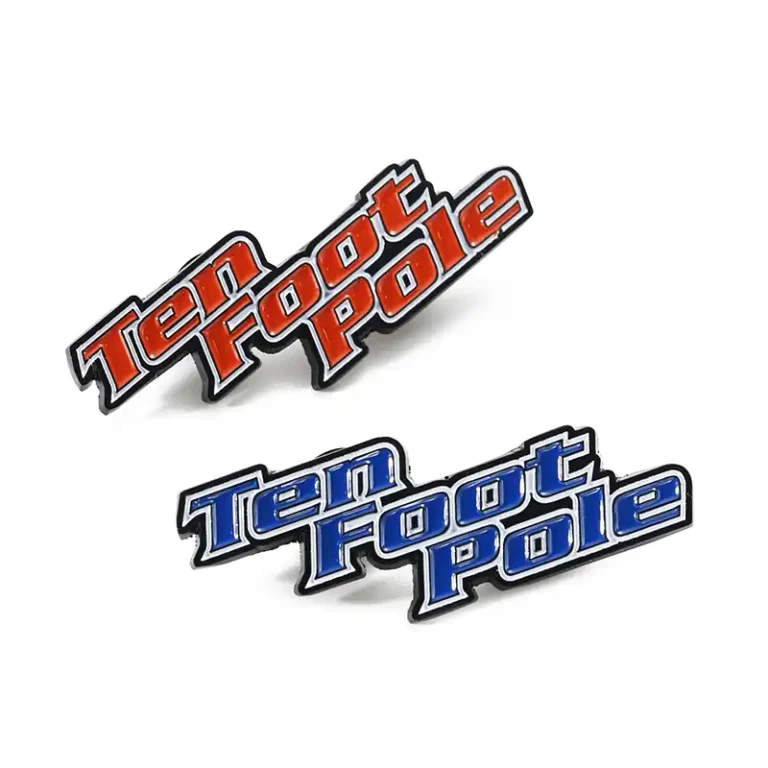
| Weiche Emaille | Metal is stamped or cast with recessed areas; color is filled into the recesses and baked, leaving raised metal lines | Textured surface, visible metal outlines, strong dimensional feel | Promotional runs, event badges, brand giveaways, artwork with bold color areas |
| Harte Emaille | Color is filled to the level of the metal lines, cured, then polished flat | Smooth, glossy, jewelry-like surface | Corporate identity pins, premium retail, collector lines |
| Die struck | Design is stamped into metal without color fill; finish comes from plating and sometimes antiquing or sandblasting | Metallic, relief-focused | Service awards, formal insignia, minimalist logos |
| Cut-out | Outline of the design is cut so the pin has negative space | Distinctive silhouette | Logos with open shapes, character or mascot designs |
If you are unsure which category fits your artwork, the article on the five main types of enamel pins explains the differences in detail. You can also browse finished examples by type: Anstecknadeln aus weichem Emaille, Hart-Emaille-Pins und gestanzte Stifte.
A practical rule: ask each candidate to show finished work in the exact construction you plan to order. A factory with beautiful hard enamel samples may still struggle with fine-line soft enamel.
What a Pin Maker Actually Does Between Artwork and Carton
Understanding the sequence helps you ask better questions, because every step is a place where quality can drift.
1. Artwork review. A competent maker checks your vector file for line widths too thin to cast, color areas too small to fill cleanly, text too small to read at final size, and gradients that cannot be reproduced in enamel. Good suppliers raise these points before tooling. A quote with no artwork feedback at all is a warning sign.
2. Mold making. The approved design is engraved or etched into a die. Stamped pins rely on a hardened steel die; cast pins use a different tooling path and suit complex three-dimensional shapes. Mold quality sets the ceiling for edge definition, so ask who makes the molds.
3. Stamping or casting and trimming. Blanks are produced, excess metal is removed, and edges are cleaned.
4. Plating. Gold, nickel, copper, black nickel and antique finishes are applied by electroplating. Ask what base metal is used and how plating consistency is checked between batches.
5. Enamel filling and curing. Color is applied by hand or semi-automatically into the recessed areas. Soft enamel is baked and left below the metal line; hard enamel is filled slightly proud, cured, then ground and polished level. Skill shows in color purity, absence of bubbles and clean separation between colors.
6. Finishing and attachments. Epoxy coating, if requested, is applied over soft enamel to create a smooth, protective dome. Backs are fitted with posts, clutches, butterfly clasps, safety pins or magnets, depending on the use. Magnet backs are the usual choice when clothing must not be pierced.
7. Inspection and packing. Each pin is checked against the approved sample and the Pantone references. Then it is counted, bagged or carded, and cartoned.
The Vendor Evaluation Scorecard
Use the scorecard below to compare candidates on the same criteria. Score each line from 1 (weak or unanswered) to 5 (clearly documented and demonstrated), multiply by the weight, and total the results. Adjust the weights to your case: a distributor may raise packaging, an event buyer schedule reliability.
| Criterion | Gewicht | What a 5 looks like |
|---|---|---|
| Construction fit | 15% | Shows finished pins in your exact type (soft, hard, die struck, cut-out) and explains tradeoffs for your artwork |
| Artwork and DFM feedback | 15% | Returns written notes on line width, color areas, text size and likely problem spots before tooling |
| Color control | 15% | Matches Pantone references, provides a physical color check before mass production, defines acceptable variation |
| Plating and material clarity | 10% | States base metal and plating options, explains how thickness and finish are consistent across batches |
| Quality control process | 15% | Describes inspection stages, defect categories and what happens to rejected pieces |
| Pre-production sample practice | 10% | Offers a paid sample or proof for approval and states clearly what the approved sample binds both sides to |
| Schedule communication | 10% | Gives a production calendar with milestones and tells you early when something shifts |
| Packaging and export capability | 10% | Handles carding, polybags, retail boxes, carton marking and export documents, and can quote delivery to your destination |
A supplier scoring below roughly 60 percent of the available points is rarely worth a trial order unless the pin is very simple. A supplier with a high total but a 1 on color control or QC should still be questioned.
Build an RFQ That Produces Comparable Quotes
Most price disagreements between quotes come from unequal specifications, not unequal factories. Send every candidate the same package.
Artwork and size
- Vector artwork (AI, EPS or PDF) with Pantone color references.
- Final size in one clear dimension (width or height) and whether the measurement includes the edge.
- A note on any element that must stay legible at small scale, such as text or a logo mark.
Construction and finish
- Pin type: soft enamel, hard enamel, die struck or cut-out.
- Plating color and any special finish (antique, sandblasted, dual-tone, glitter, glow, epoxy dome).
- Number of colors and whether any areas are left unfilled.
Attachments and extras
- Back type: butterfly clutch, rubber clutch, safety pin, magnet, locking pin.
- Individual packaging: polybag, backing card, gift box, custom printed card.
- Any numbering, serial marking or back stamp.
Commercial terms
- Target quantity and any split across designs or sizes.
- Required delivery date and destination country.
- Pricing basis: ask for the delivered price to your address (DDP) so duties and freight do not appear as a surprise later.
- Sample terms: ask the cost and timing of a paid pre-production sample and what it will be compared against.
If you want a structured way to submit this, the lapel pin quote form (linked below) collects most of these fields, and the custom pins page outlines the customization options available.
Audit Questions That Separate Manufacturers From Order Takers
Some sellers are trading intermediaries; some are true factories; many are somewhere in between. Neither model is automatically wrong, but you should know which you are dealing with, because it affects accountability.
- Which steps are done in your own facility, and which are outsourced? Tooling, plating and enamel filling are the three that matter most.
- Who makes the mold, and can I get the die kept for repeat orders? Mold ownership and storage policy should be written down, not assumed.
- How do you confirm color before mass production? Look for a defined method: Pantone reference, physical sample, or photo approval, with a stated tolerance.
- What do you do when my artwork cannot be reproduced as drawn? The right answer is a marked-up proposal, not silence.
- What are your inspection checkpoints? Expect at least an in-process check after enamel and plating, and a final check before packing.
- What defects do you reject, and what do you accept? Bubbles, overflow between color cells, scratches, plating blemishes and bent posts should all have a defined treatment.
- How are replacements or credits handled if a shipment is faulty? Ask for the process in writing before you place the order.
- Which export documents and delivery terms can you handle? For international buyers, the ability to quote delivered pricing and manage customs paperwork removes a lot of risk.
- Can you describe your production calendar? Look for a clear sequence of artwork approval, sample approval, mass production, inspection and shipping.
FOR BRANDS & DISTRIBUTORS
Comparing pin makers for your next order?
Hesank is a pin factory, not a reseller. Send your artwork and we return a design proof and specification you can score against other suppliers. MOQ 50 pcs, free design proof, 12–15 days production.
Quality Checks You Can Perform Yourself
When a pre-production sample or delivery arrives, a short checklist covers most issues: measure size and silhouette against the proof; check Pantone references under neutral daylight; confirm soft enamel sits slightly below the metal lines and hard enamel is flat to the touch; look for bubbles, pits and contamination in large color areas; inspect plating for uneven color, scratches and rough edges; test that posts are straight and clutches hold; and pull several pins from different cartons to compare them with each other, not just with the sample. Define acceptance criteria in the purchase document before the order, so a disagreement about “a little off” has a standard to be measured against.
Packaging and Delivery: The Part Buyers Forget
Pins are small, and a damaged presentation can undermine a well-made product. Decide these points early:
- Counting method: how many pieces per bag, per card or per box, and how cartons are marked.
- Protection: separate bags prevent scratching; backing cards keep post and clutch in place for display.
- Retail packaging: if you are selling at shelf or through distributors, specify barcode, branding and card print before production, not after pins are finished.
- Delivery basis: under DDP terms, the supplier arranges export, freight and import clearance up to your named address, which makes landed cost easier to compare. Confirm exactly what the quotation includes.
Common Mistakes When Choosing Custom Pin Makers
- Comparing price without comparing specification. A lower quote often means thinner plating, fewer color checks or a different pin construction.
- Skipping the pre-production sample. A paid sample costs far less than reworking a full run.
- Choosing hard enamel for artwork that needs fine detail. Hard enamel needs enough space between color cells; very thin lines are better served by another construction.
- Approving artwork with text that is too small. Legible on a screen is not the same as legible on a pin.
- Leaving replacement terms unwritten. What is not written down is hard to enforce.
Häufig gestellte Fragen
What is the difference between soft enamel and hard enamel for wholesale orders?
Soft enamel leaves the color slightly recessed below the metal lines, giving a textured surface, and is a common choice for promotional and event pins. Hard enamel is filled and polished flat, producing a smooth, jewelry-like finish that suits brand identity and retail lines. The choice depends on the artwork detail, the look you want and the budget.
How should I compare quotes from different custom pin makers?
Send an identical RFQ to each: same artwork, size, pin type, plating, attachments, packaging, quantity and delivery basis. Then score the responses with a weighted scorecard rather than by price alone, and ask for a paid pre-production sample from the finalists.
Do I need a pre-production sample before mass production?
For anything beyond a very simple repeat order, yes. A sample confirms color, size, plating and attachment before the full run begins. Samples are a paid item, and the fee is small compared with the risk of correcting a complete production batch.
What should I check when the pins arrive?
Check dimensions against the approved sample, color under neutral light, enamel fill level, plating quality, posts and clutches, and consistency across several cartons. Agree the acceptance standard and the remedy for defects in advance.
Weiterführende Literatur: how much custom pins cost, choosing pin backs und what a lapel pin is. Durchsuchen Anstecknadeln aus weichem Emaille und Hart-Emaille-Pins.
Request a Quote for Your Lapel Pin Order
Wenzhou Hesanqian Crafts Co., Ltd. has been manufacturing metal crafts since 1996, including lapel pins, challenge coins, medals, keychains, bookmarks and badges, with DDP delivery to more than 30 countries. If you have artwork and a target quantity, send them through the lapel pin quote page, or reach the team directly via the contact page. We will review the artwork, flag anything that needs adjustment, and provide a specification you can compare against other candidates on your scorecard.